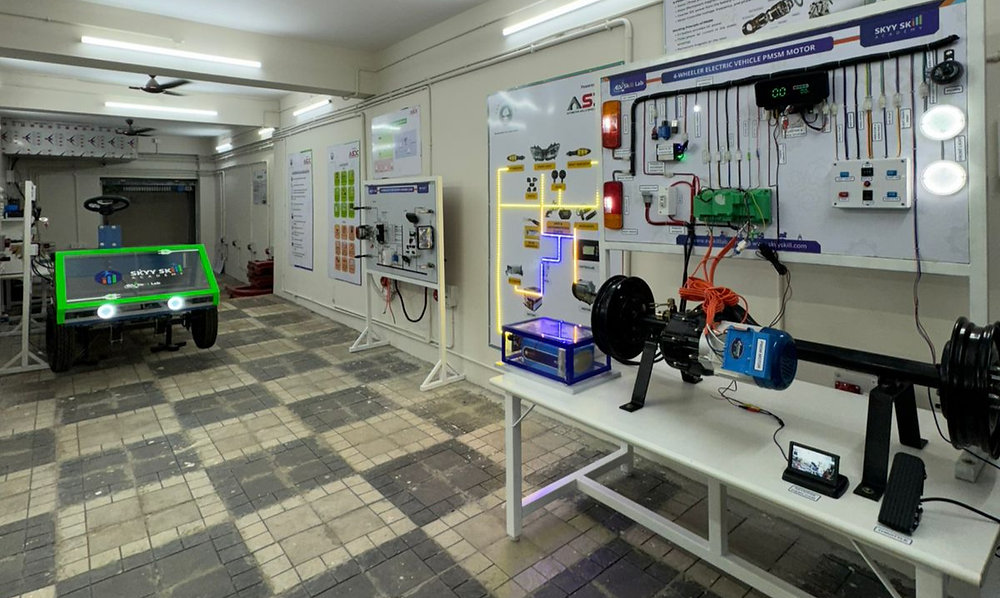
The EV powertrain has become the engine of electric vehicles, replacing the loud engines and fuel tanks with smooth and environmentally-friendly solutions that are much more efficient and reliable. In the university lab, students and researchers actually have to put their hands on these parts in real experiments, computer sims and test rigs. It concerns nothing more than putting the classroom theory into practical skills of creating a greener future in transportation.
Getting into the EV Powertrain Basics
Consider the EV powertrain to be the one-stop system that stores energy, transforms it and propels the vehicle. It has approximately 60% fewer parts than the old-school gas cars so there is less to deal with when it comes to maintenance and breakdowns. The key actors are the storage battery, conversion and drive inverters and motors and controls to ensure everything is humming. At the laboratories people can use mini models, dynamometers, and sensors to explore such things as energy efficiency, heat management and smart controls.
Battery Pack: Where the Juice Comes From
At its core, the battery pack usually stacks of lithium-ion cells in modules holds the electrical energy that powers everything. It pumps out direct current (DC) to kick things off.
In the lab, students hook up battery management systems (BMS) to track voltage, current, and charge levels. They run tests like cycling the battery through charges and discharges, checking for overheating risks, or seeing how capacity drops over time. Good cooling systems are key to keeping cells happy and lasting longer.
Traction Inverter: The Smart Converter
This gadget flips DC from the battery into AC for the motor, and it even recaptures energy during braking to recharge on the go.
Lab sessions mimic real driving with simulated routes to check efficiency, heat from switching, and cooling setups. Researchers geek out on next-gen materials like silicon carbide for handling higher voltages with less waste heat.
Electric Motor: Turning Power into Go
The motor takes that electrical energy and spins it into torque for quick, smooth acceleration. You’ll see types like permanent magnet or induction motors, often with a simple gear reduction to match wheel speeds.
On dyno benches in uni labs, teams map out torque curves, efficiency at different speeds, and regen braking. They tweak vibrations, quiet things down, and fine-tune software for a better ride.
Extra Bits and the Brains Behind It
Don’t forget the onboard charger for plugging into the grid, DC-DC converters for gadgets like lights, and the main controller tying it all together. The BMS watches over the battery like a hawk, and power distributors keep the flow safe.
Labs build full mock-ups for troubleshooting faults, optimizing setups, or testing under different stresses—like heavy loads or long hauls—to squeeze out more range.
Getting Hands-On in University Labs
These spaces are equipped with cool gear like rolling road dynos, full powertrain stations, and even battery-building lines. Students dive into piecing components together, charting efficiencies, and coding controls. It’s the perfect training ground for tackling real-world EV challenges.
Wrapping up, the EV powertrain pulls all this together for smooth, emission-free drives. University labs are where the magic happens, sparking ideas through trial and error. With EVs taking over the roads, knowing this stuff inside out is a game-changer for tomorrow’s engineers.
